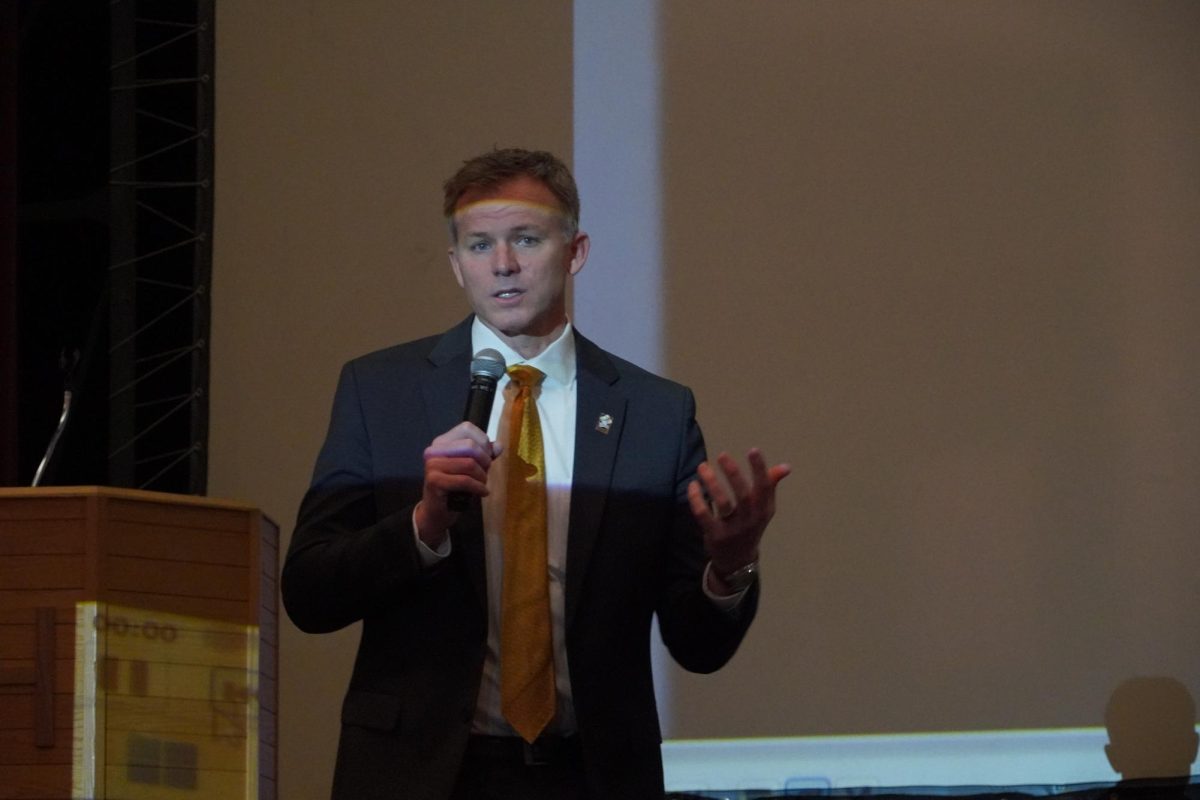
Christopher Sullivan is the director of education at Sky View Academy – an adult education program at the Utah State Prison that gives inmates who did not complete high school the opportunity to earn their diplomas. He has been doing alternative education for 28 years having spent 23 years teaching at Horizonte, one teaching at the homeless shelter, one in Jordan School District, and almost four at Sky View Academy.
Never has the school-to-prison pipeline (STPP) been more real to Sullivan. He has seen first-hand what factors contribute to young people finding themselves incarcerated. And Sullivan believes schools share much of the blame.
“A lot of our students (at Sky View) lack self-confidence because for whatever reason school was not a safe place for them,” Sullivan said. “They didn’t feel welcomed, they didn’t feel trusted, and they didn’t feel like it was a trusted place and so they didn’t get the ability to build (standard reading and comprehension) skills and so I want them to be able to build those skills.”
The STPP is the belief that certain patterns of inequitable disciplinary decisions and policies push certain kids, particularly students of color, into a path that leads them to become justice involved. Some students just don’t get the same level of support as other students, according to researchers, and this lack of support is due to a number of reasons, including flaws in both the education and prison systems.
Being at the state prison and working with incarcerated students, Sullivan has talked to many students who didn’t feel supported in school which has affected the way they learn and the way they see themselves. A lot of students who are first entering Sky View Academy avoid classes, homework, and interactions with educators because their self-esteem has been crushed by their previous experiences in school, according to Sullivan.
Interactions and experiences like these have helped Sullivan shape a strong understanding of the STPP and what should be done to reverse the trend.
According to a 2020 article published by Sage Journals, “a suspension serves as a key turning point toward increased odds of incarceration, even after accounting for key covariates including levels of criminal offending.”
This means that receiving a suspension, even short-term suspensions, can shape the life-course of students. When students are removed from school through suspension, they lose instructional time, fall behind academically, and are more likely to disengage from education.
Of particular note is that students of color are more likely to receive punishment in school than other students.
A 2026 education report by ZipDo showed that Black students are about 3.6 times more likely to be suspended than white students, while Hispanic students are 2.1 times more likely to be suspended and Native American students are 2.3 times more likely to be suspended. Students of color face significantly higher suspension rates than white students and it is inequitable disciplinary choices like these that contribute to the school-to-prison pipeline.
This data is also apparent in Utah schools.
The Utah State Board of Education’s 2025 School Disciplinary and Law Enforcement Action Report counted the number of lost days of instruction due to exclusionary discipline – in-school and out-of-school suspensions – per 100 students based on race/ethnicity groups. They found that African American/Black students lost 19.8 days, Native American students lost 19.4 days, and Hispanic/Latino students lost 13.7 days per 100 students. In contrast, white students only lost 5.5 days per 100 students.
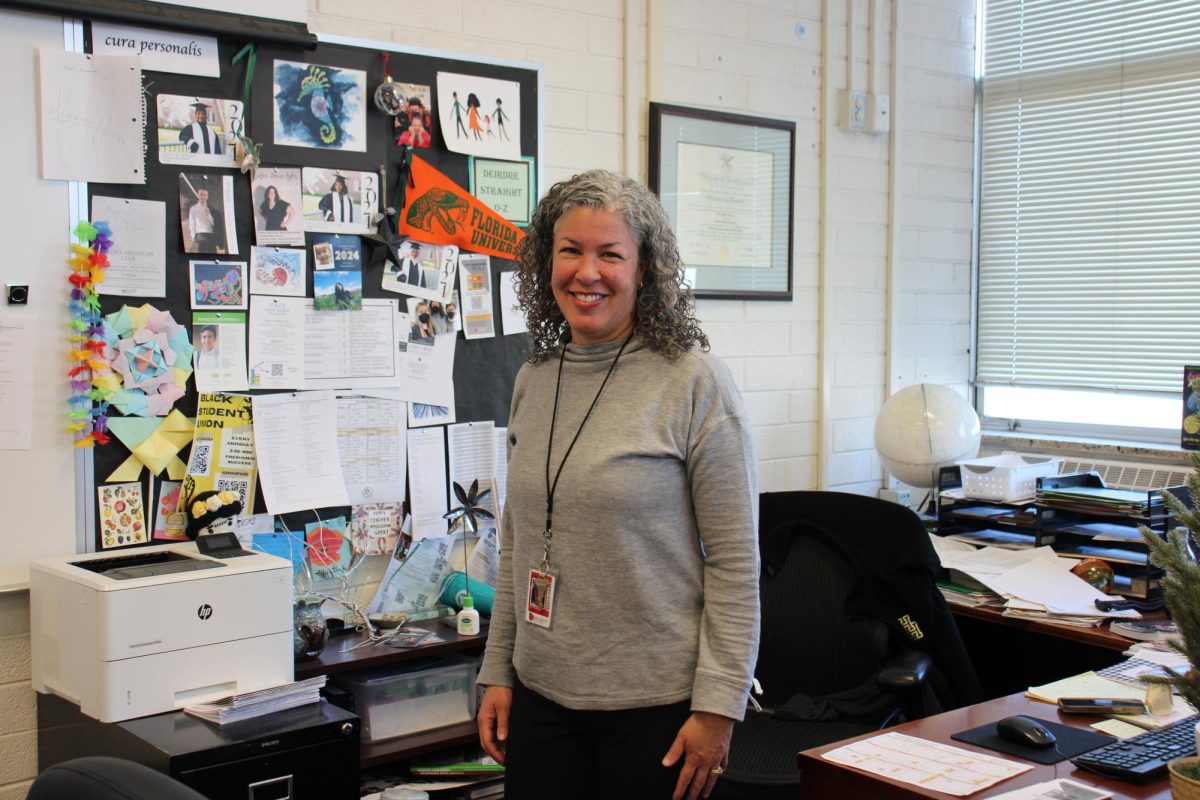
Highland principal Jeremy Chatterton is aware of the inequity in Salt Lake City School District.
“There’s a huge discrepancy in our district,” Chatterton said. “There’s no doubt between what’s happening in like east-side elementaries and west-side elementaries. It’s pretty obvious when you look at test scores; it’s pretty obvious when you look at a lot of different pieces.”
Many believe this discrepancy is due to the makeup of the Salt Lake City School District, which features some of the wealthiest neighborhoods in the state and some of the most socioeconomically challenged. And this mix can create challenges, according to Chatterton.
“Salt Lake District is a challenging situation in that it’s almost two districts in one in terms of what you see score wise and what you see discipline wise between the two demographics,” Chatterton said.
While some believe that this is a key contributor to the STPP, Sullivan views things differently. Sullivan believes that lack of support from teachers and administrators plays a vital role in the STPP.
“People make it harder than what it should be,” Sullivan said. “My experience is: the best way to combat the school to prison pipeline is to have teachers who actually form relationships with students — teachers who actually get to know their students and who actually understand how their students operate and what is going on in their students’ lives.”
To Sullivan, teachers and administrators who truly know their students will be more interested in helping them rather than punishing them. And it may not be common knowledge, but Sky View is actually a part of Salt Lake City School District.
One way schools are also looking to combat this inequity is through restorative justice. A practice that provides students with opportunities to redeem themselves through restorative conversations, study hall, and other methods rather than facing strict, exclusionary discipline such as zero-tolerance discipline.
One example of restorative justice used by the Salt Lake City School District is peer court. Students who get into trouble at school can be referred to peer court by an administrator or resource officer. The student then answers questions in front of a panel of students, who then recommend a contract that students are required to fulfill. The contracts typically lay out specific non-punative steps the students can take, such as community service, research projects, and meetings with mentors.
A study by the University of Chicago’s Education Lab found that, “…restorative practices reduce student arrests in and outside of school and for violent and non-violent offenses, and may generate positive, genuine changes in student behavior. Schools that implemented RP policies saw a staggering 35 percent reduction in student arrests in school and a 15 percent reduction in out-of-school student arrests. The study saw declines in arrests for both violent and non-violent offenses.”
Restorative justice reduces exclusionary disciplinary policies that prevent students from receiving important instruction by suspending them without really addressing the root of the problem, something Sullivan is not a fan of. It also helps students of color, who face more discipline than any other group.
A report by the Bureau of Justice Statistics and U.S. Census Bureau data found the percentage of people in state prisons per 100 state residents in different race/ethnicity categories in 2021. The data showed that nearly 1.3 out of every 100 Black residents is incarcerated as are nearly 1.3 out of every 100 Native American residents while only about 0.1 out of every 100 White residents are incarcerated.
Sullivan knows that people of color are more likely to become incarcerated for several reasons, but Sullivan believes change in schools can aid in lessening the problem.
Sullivan believes that while zero-tolerance policies are appropriate in serious circumstances, they aren’t needed in most cases. He believes more can be accomplished by simply communicating and trying to understand how to help the student rather than just forcing them to miss school.
“…If you can form relationships and actually sit down and know your students, once you make that connection, learning becomes so much easier,” Sullivan said. “To me, if we can have the capacity to do that, I think that would end a lot of our issues.”