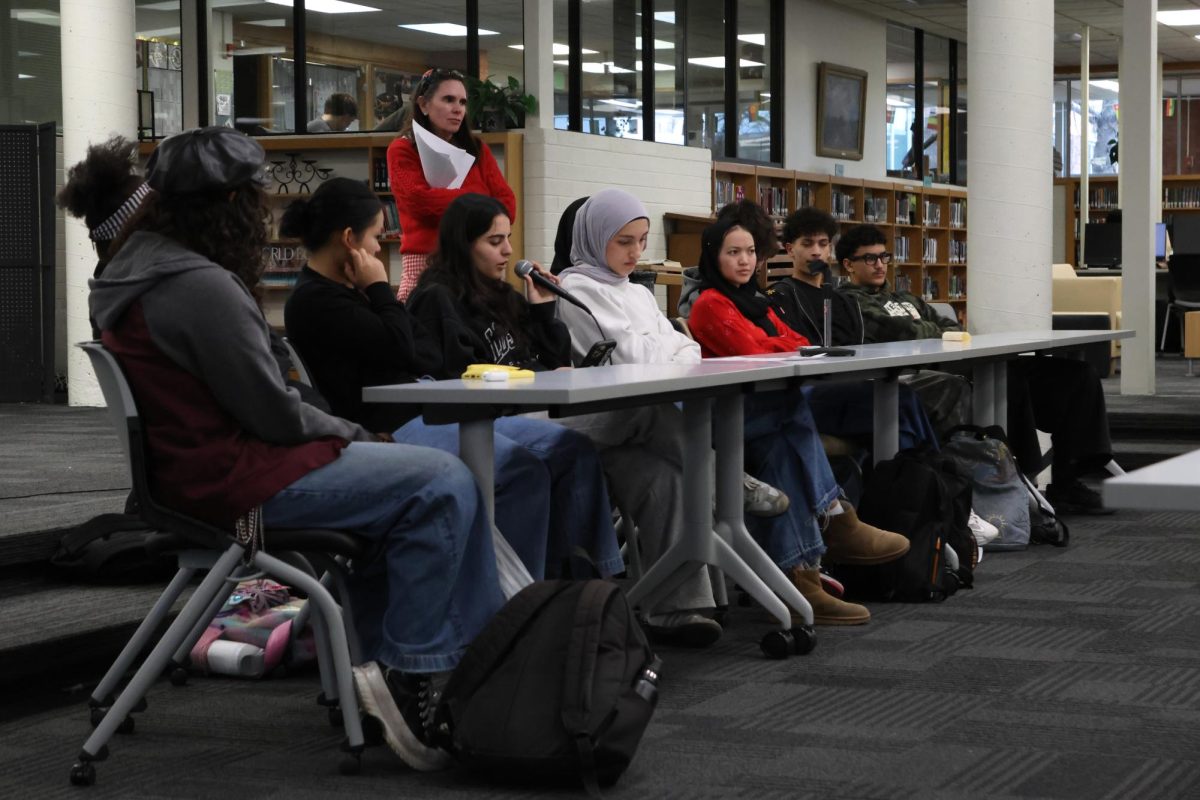
Carmen LeCluyse does a demonstration with recyclable materials for the environmental club.
The Salt Lake School District has a goal to be 100 percent carbon neutral by 2030 as it continues to strive for sustainability.
Recycling is the basis of sustainability. It is a common way for paper, cardboard, plastic, and aluminum disposables to be reused instead of being dumped into the landfill where it would otherwise sit for thousands of years.
But at Highland, recycling bins are absent from most classrooms, raising questions about why recycling is not being practiced as much in spite of this sustainability goal.
“I was really disappointed when I came back to school this year and just didn’t have recycling,” environmental club president Carmen LeCluyse said.
Many Highland teachers were also confused by the change as they were not aware that requesting a green bin was an option. But according to Salt Lake City School District Assistant Custodial Manager Samuel Mills, recycling is still a fundamental part of the district’s Sustainable Action Plan and it should be in full effect at Highland, though there has been confusion around Highland’s recycling program. This confusion is because of the removal of these bins without any communication.
October 9th, an email was sent out from Highland’s head custodian Mathew Lilly to staff opening with, “Rumor has it Highland High does not recycle any more. That is false.”
Lilly’s email explained to teachers that recycling is still available to them upon request.
The reasons for the confusion involve miscommunication and misuse of recycling bins.
Years ago, many schools in the Salt Lake Valley, Highland included, participated in a paper recycling program through Green Fiber. The program was based around collecting paper, fireproofing it, and turning it into insulation for homes. The district was compensated for every ton of paper that was collected.
Since then, the COVID-19 pandemic led to most classrooms going to digital assignments, leaving Green Fiber at a loss. The company was losing money by paying for workers and fuel to collect the material. The program was discontinued and many other districts that were using this program resorted to removing recycling programs altogether. Due to the Sustainable Action Plan implemented in 2020, that was not an option for the Salt Lake City School District.
Working with ACE Recycling, the district was able to come up with a plan to continue paper and single stream recycling. ACE purchased the dumpsters from Green Fiber that were already on the property and began collecting paper recycling from the schools at an extra cost.
There are three waste bins at Highland: blue, green, and black. The blue bin is meant for single stream recyclables that include anything from plastic to paper. The green bin is for paper and cardboard only, while the black bin is for non-recyclable items such as food waste and some plastics. Highland now only offers black bins and, upon request, green bins.
Last year, in an attempt to cut costs, the district put out a bid to look for a more affordable way to continue recycling, according to Mills. Unable to make another company work, ACE Recycling began collecting the single stream and paper only recyclables in one truck. The materials are then sorted at the facility.
This change that came to Highland over the summer is rooted in a simple, but consistent, problem: many blue and green recycling bins in classrooms ended up contaminated with food, plastics, or other non-recyclable materials. If mixed in with recycled materials, this could cause an entire dumpster or even truckload to end up in the landfill.
One of of the final products from the environmental club’s activity.
“Part of the problem was just that even though we were offering recycling in classrooms, it was often being contaminated,” Highland principal Jeremy Chatterton said.
The problem was that students were not putting the correct waste in the correct bins, which resulted in pests – ranging from rodents, to bugs, to bacteria – in and around unsorted recycled items.
Mills verified that Highland’s custodial staff had been utilizing a plan to limit contamination. By only providing a green recycling bin upon request, they could ensure that only teachers that would enforce the recycling policy would have one in their classroom.
“Classrooms can request either a paper-only can or a single-stream can, depending on what works best,” Mills said in an email. “That process is in place because of contamination issues.”
A main reason for this year’s change is Integrated Pest Management (IPM), a science-based pest control strategy that uses different methods to prevent damage from pests such as bugs, weeds, bacteria, or wildlife. This can include targeted treatment, managing food and water, and ensuring there are minimum places for pests to live. By enforcing the sorting of recycled materials, the Highland custodial staff hopes to limit the amount of food waste that goes into blue and green bins, which attract bugs and wildlife.
“We don’t want a can in there that may potentially have liquid or food because the students aren’t using it properly and the teacher is not doing the recycling part,” Lilly said.
Last year, Highland’s environmental club recognized the issue and attempted to solve it by making cardboard toppers for recycling bins that had shaped holes for what was meant to go inside. For example, if it was a blue bin, there was a circular hole to fit bottles or cans. If it was a green bin, it had a slit large enough for paper or cardboard to fit inside.
“Our environmental club tried really hard to make [recycling bin toppers] from unused boxes to help kids to know what goes in and out of them,” Nancy Wright, the environmental club advisor said. “And that was really good. And a lot of kids did that.”
The club members collected information from the teachers that were given the bin toppers and concluded that it had an overall positive impact.
Now that classrooms will only have one recycling bin, students and staff will no longer need to separate the paper-only and single stream recycling. All recycling will go in the green bin while non-recyclables will go in the black waste bin.
“All the teachers have to do is request a green can and then I’ll bring them a can,” Lilly said. “Not all teachers want to participate. So if they don’t want to participate in the recycling, they don’t have to.”