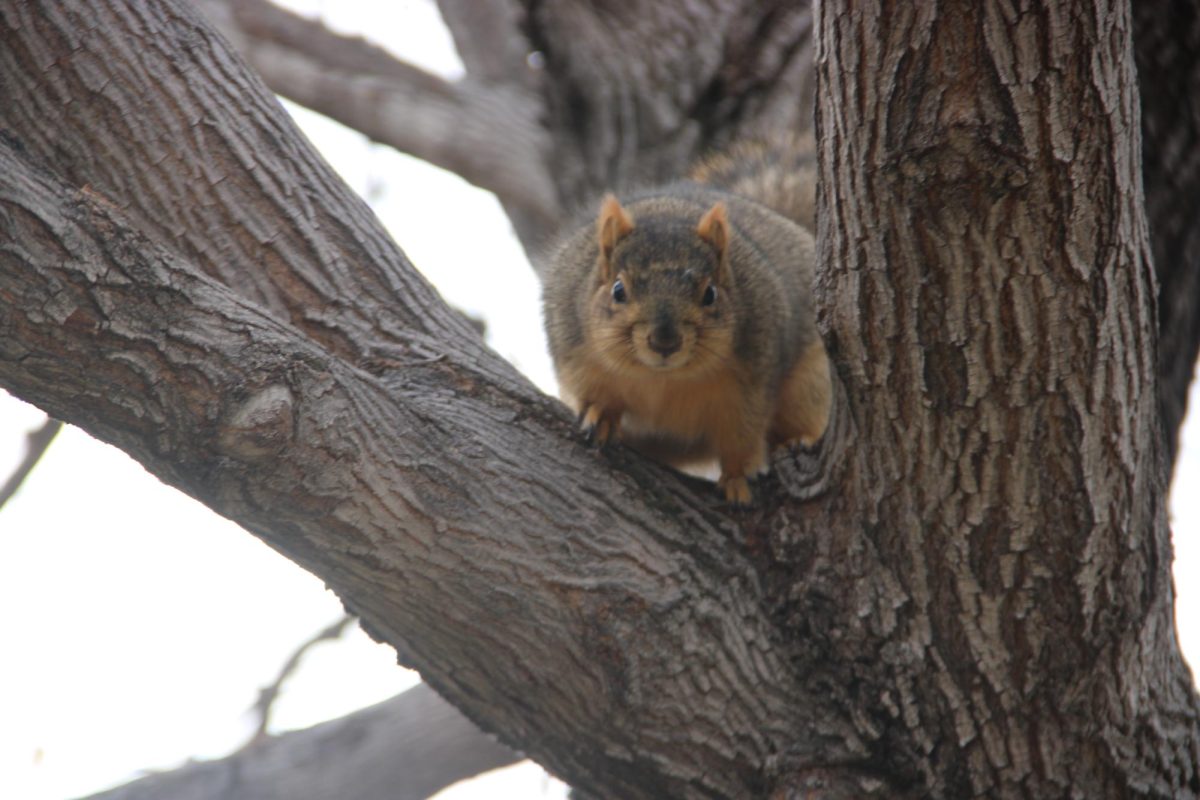
Last year, Vada Foster was walking up the stairs to her first period class when something fell on her shoulder from the ceiling. It was not a piece of the ceiling, or something thrown by another student. In fact, it was the last thing she ever expected — a squirrel.
The squirrel landed on shoulder before scurrying away. Now, whenever Foster hears the scurrying of rodent feet in the ceilings above the E-hall, she braces for impact. She’s experiencing PTSD – Post Traumatic Squirrel Disorder.
“For the first week, I would always look up when I was walking up the stairs,” Foster said.
Although she has not been bombarded again, the squirrels haven’t left. Students and teachers have been hearing the scurries of the squirrels in the ceilings during class for four years.
The second floor of E-hall is housing squirrels in the ceiling. They have been living there despite the custodian’s best efforts to keep them out.
Foster isn’t the only person to have run-ins with squirrels.
Kelsey Hill-Cucuk, a language arts teacher at Highland, notices the squirrels all around her classroom. They play up in the ceilings, making it their new home, and they consistently come into classrooms to say hello. Last week, during Hill-Cucuk’s 4th period, a squirrel came out of the ceiling and began running loose in her classroom.
One student noticed the presence of the squirrel and told Hill. Maintaining calm with 36 students and a squirrel was not easy, Hill said. Everyone wanted to pet or take pictures with the squirrel, but the squirrel especially liked Hill.
“The squirrel started climbing up my pant leg, and students said, ‘Mrs. Hill, the squirrel’s moving!’” Hill said. “And I was like, ‘I know the squirrel’s moving! I can feel it moving.’ But eventually we got everyone downstairs.”
Even when the squirrels are not in the classroom, students get distracted easily because they can hear them frolicking in the vents above.
“I administered the ACT in my room last year and the squirrels were active in the middle of the ACT, which was really upsetting,” Hill said.
Griffin Kerr, also a language arts teacher at Highland, has had at least five squirrels removed from his ceilings since the beginning of the year. Highland’s custodians have been taking care of the problem squirrel by squirrel by setting catch-and-release traps and putting them back outside.
In Kerr’s room, squirrels have been caught in traps using granola bars as bait.
Highland head custodian Mathew Lilly is doing all he can to fix the pest problem, but there are no good ways to humanely remove the squirrels without them returning to their new homes in the ceiling. The district has tried to fill the holes in the building’s exterior, but the squirrels are not deterred.
“The past three years, [the district] has gone through the entire exterior of the building and sealed all areas where they could be getting in. In one hole though, they chew their way back through,” Lilly said. “And now we need to get it fixed again, so it’s scheduled to get fixed.”
Lilly says that one thing teachers can do is close their windows, especially at night. Squirrels find the open windows and enter as they please.
And even though Lilly is removing the squirrels, they just keep coming back.
“With catch and release, they go back to the same entry, come back, we catch, and we release. Hence, four years,” Hill said.
During a recent visit to the school, Highland superintendent Dr. Elizabeth Grant paused during her remarks to The Highland Rambler to ask, “are those critters in the ceiling?” when she heard scurrying above her.
She smiled upon the realization.
“I guess it’s good we are getting a new school,” Grant said.
Highland’s custodians hope that will lead the squirrels to a new home. But for now, students should be on the lookout for falling squirrels.