Online classes have traditionally been an easier way for students to earn required credits and make room for electives in subjects that truly interest them.
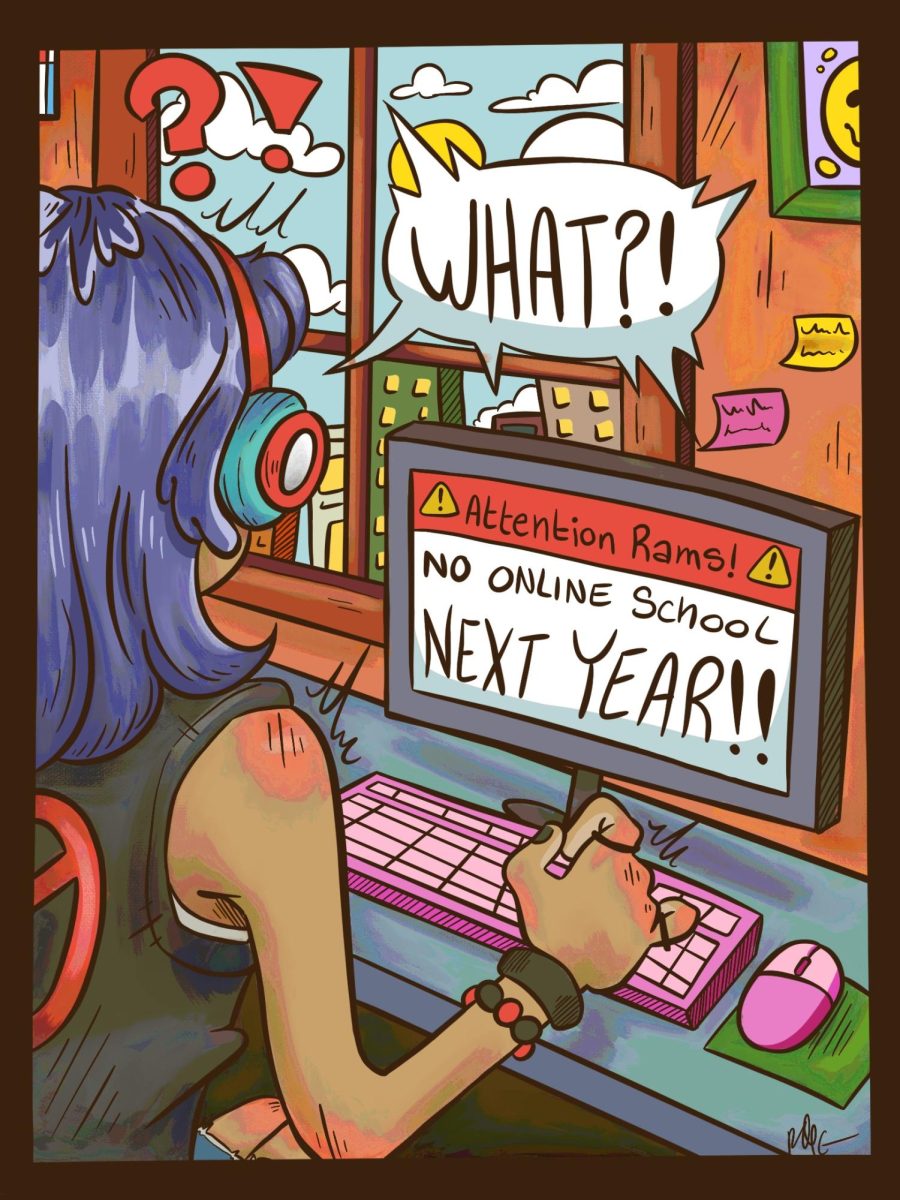
But that just became more difficult.
Leading up to this year, Highland students have been allowed to register for free online classes in addition to taking a full schedule. However, this will no longer be the case next year due to a state policy that the Salt Lake School District will begin enforcing in the fall of 2026.
In November of 2025, policy R277-726 went into effect across the state. Included in this policy is a section that states: “The sum of program and physical credits may not exceed full-time enrollment unless a plan for early graduation is reflected in a student’s records.”
This means all students will be limited to taking eight credit hours per year, including summer and online classes. The policy is technically not new but has not been enforced until now.
“It’s information that, here at Highland, we are just now putting into place,” Highland principal Jeremy Chatterton said. “And anytime something changes, it’s going to cause some concern amongst everyone. And so we’re trying to now kind of put the plan in place of how we’re going to do it.”
If a student decides to enroll in online classes for credits, they will not be able to have a full class schedule at Highland. This means for every online class a student takes, they will need to take a corresponding home release period.
“The decision was presented to us maybe a month ago with the idea that we would then police it,” Highland counselor Lisa Madsen said.
Students who sign up for more than the allotted credits will have classes removed by Highland counselors, who were asked to deliver this news to students during class selection this month.
However, there is still an option for students to earn more than eight credit hours each year. They won’t be able to do it through the State Online Education Program (SOEP), but can use Northridge Learning Center to purchase a non-fee-waiverable packet. Completed packets can be returned to Northridge, which will then send confirmation of completion to Highland, and the credit will be added to the student’s transcript.
This policy enforcement will have a major impact on a wide range of students. Counselors worry that students who were counting on taking extra classes to make room in their schedules aren’t going to be able to be involved in as many school activities and they won’t be able to take as many classes as desired.
Giving a student their desired schedule is difficult for counselors as is, due to limited class availability and scheduling conflicts. There are several classes that are only offered during one period of the day. AP calculus AB is only offered during 3A, journalism is only 2A, student government is only 3B, and the list goes on. This gets even more complicated when factoring in graduation requirements, CTE pathways, and student interests.
Because there are so many things to consider when making course selections, counselors meet with students their freshman year to create a “four-year plan.” This is a tentative course schedule that allows students to make sure they meet graduation requirements while pursuing their interests. However, with this new policy being enforced next year, the four-year plans of students for classes 2027, 2027, and 2029 are being disrupted.
Madsen wishes those in charge of creating the policy had communicated the decision to make changes sooner.
“I wish that folks who made these decisions would talk to counselors, the people that are actually meeting with students,” Madsen said. “I would tell them, ‘make a change like this at the very beginning of ninth graders’ year so that it’s part of their plan. Don’t do something big in the middle of a year.’”
The driving force behind this policy comes down to one thing — funding.
“So, what we’ve been told is that it’s not something new. It’s something the state has expected in terms of where the FTE money – the money that we get per student – has been supposed to have been split for a while and has been.”
According to Chatterton, Highland gets around $4,000 from the state for every full-time student. However, when a student decides to enroll in online classes, the school has to send a portion of that money to the online institution that the student has chosen.
Therefore, the reason a student can opt in for a packet is because Highland is not responsible for paying Northridge Academy, the student is.
There seems to be some confusion surrounding the situation. Highland counselors and Chatterton are anticipating a new policy, whereas Tiffany Hall, Executive Director of Teaching and Learning for Salt Lake City School District, says a policy is already in place.
Highland counselors are also under the impression that the district lost $1.2 million dollars last year whereas Hall states, says the money wasn’t necessarily “lost.”
“We didn’t ‘lose’ the money; we paid about $1.2 million dollars for students to take classes from the SOEP program,” Hall said. “…We paid for students to attend classes at two schools and possibly for more than full-time attendance. This can result in students taking more classes than we are funded for them to take, which creates a deficit in the funding we receive per student.”
This situation and the communication surrounding it has left counselors frustrated.
Madsen is also concerned about the impact this policy enforcement will have on students.
“I’m worried about the high-achieving kids who want to get their total money’s worth by doing extra stuff during high school. It’s going to affect those, and it’s going to affect the fee-waiver kids,” Madsen said. “And my biggest problem is why can’t we have some conversations about this first? Instead, in February, you’re having us share this message, and it’s unfair.”
Madsen believes this to be an inequitable change; however, Hall does not.
“I don’t believe that this policy is inequitable. Students are required to earn 24 credits to graduation, and they have the opportunity to earn 32 credits with the 8-class x 4-year schedule,” Hall said.
In addition to the state limiting credit hours, the district has decided to change the credit hour count of Concurrent Enrollment (CE) English courses.
Leading up to this point, students who enrolled in single semester CE English classes could earn a full credit hour. However, next year those same courses will only be counted as 0.5 credit.
The issue with this change is the time it was announced. According to Madsen, the counselors were informed about the change on February 2, just a few days before course selections were supposed to be turned in.
“The thing that makes it really hard for me as a counselor is, I’ve already given a different message to every kid before receiving this change,” Madsen said. “We’re just at a disadvantage if you add something new this late in the game.”
Both the credit hour policy enforcements and changes have been communicated to students through counselor classroom visits. However, there has not been an official email or message sent out to parents and families.