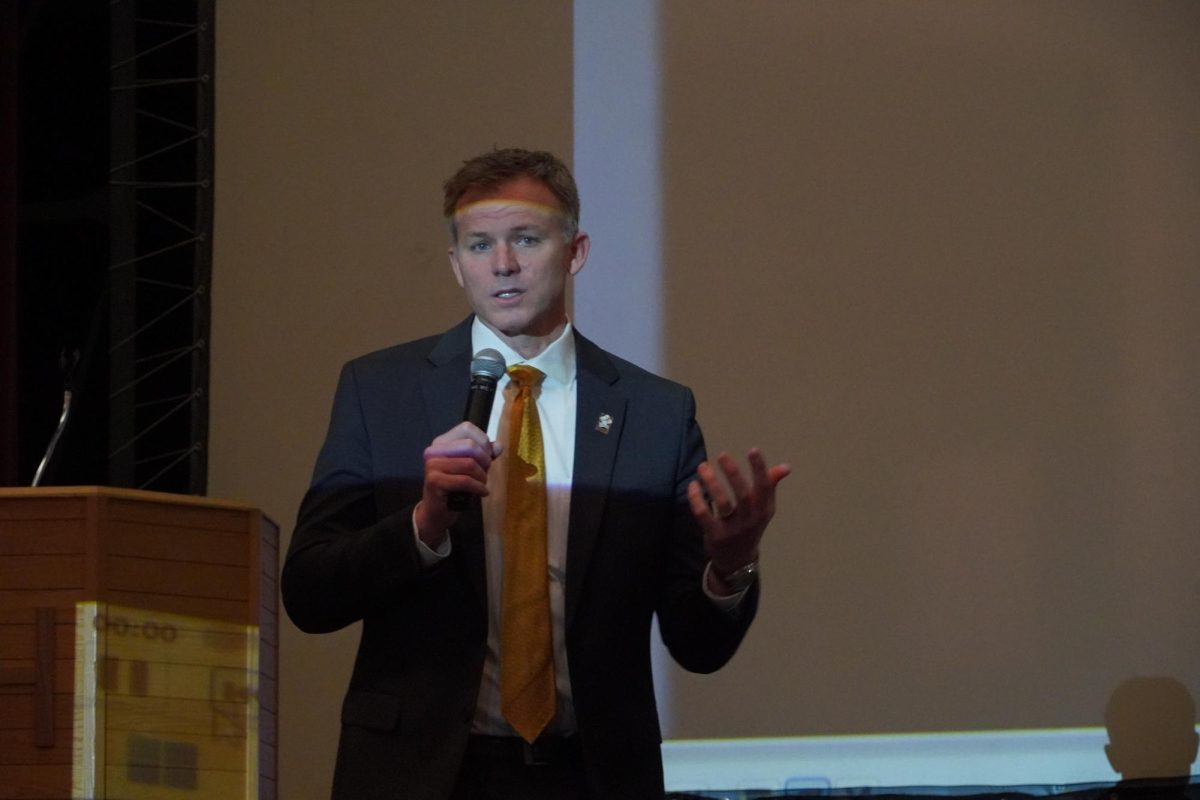
Blake Moore is a Republican U.S. Representative for Utah’s 1st Congressional District. Representative Moore spoke at Highland on February 26. He talked about the state of politics currently, and feeling like it can be hard to have hope and hard to have respectful disagreements.
Moore shared with us personal stories about his and his parents’ lives, who are interconnected with the school itself. He also shared about his daily life in politics and why he loves his job. At the end of his talk, he asked the audience if anyone had questions for him.
The energy that followed his offer was undeniable.
Students’ questions involved topics such as Moore supporting big corporations or ‘the people’. They also included his stance on the conservation of the Great Salt Lake, and Moore’s signing of Public Law 119-21, more commonly known as the Big Beautiful Bill.
Students brought up real numbers and facts, such as the percentage of Moore’s funding coming from large corporations.
Moore was clear to point out that the internet and social media have a way of spreading misinformation or not accurately depicting the full nature of certain topics.
“Do not rely on anybody else to do the understanding and the research,” said Moore. “Dig in, understand the details, and take it all in”.
Speaking of taking it all in, the auditorium was electric. Students with questions seemingly gained confidence from each previous question asked. The ability that students, teenagers, were able to challenge Moore’s ideas and ask for more information was surprising. And powerful.
Murmurs filled the room, but they grew louder throughout the final minutes, with students even erupting into cheers, claps, and whistles, prompted by a fellow students’ questioning Moore’s support of the Big Beautiful Bill.
I believe it’s incredibly beneficial for political figures to speak with teens. Politicians so often see the demands of older generations; and as teens, without being able to vote, our needs and values can be easily overlooked. Being able to speak with a younger audience can lead to a broader perspective, and potential changes.
In history, it takes effort for passionate young people to spark change. However, now with the digital age, we can more easily express our beliefs, find our community, and do something about it. It seems that there is a high awareness of political issues amongst teens, with the state of the world so constantly being thrust in our faces.
Moore addressed the feeling of hopelessness, like it can seem difficult to wake up and feel optimistic when we hear about so much hate in the world through social media. The ability to connect with a real figure with political influence makes politics seem less as a faraway, abstract concept, and more like something attainable that we can influence.
Politicians having conversations with teens sparks change, holds the speaker accountable, and makes politics feel less intimidating. These kinds of conversations, when done correctly, feel as though progress can be made to match younger views.